
REGENT Secures $240 Million Series B
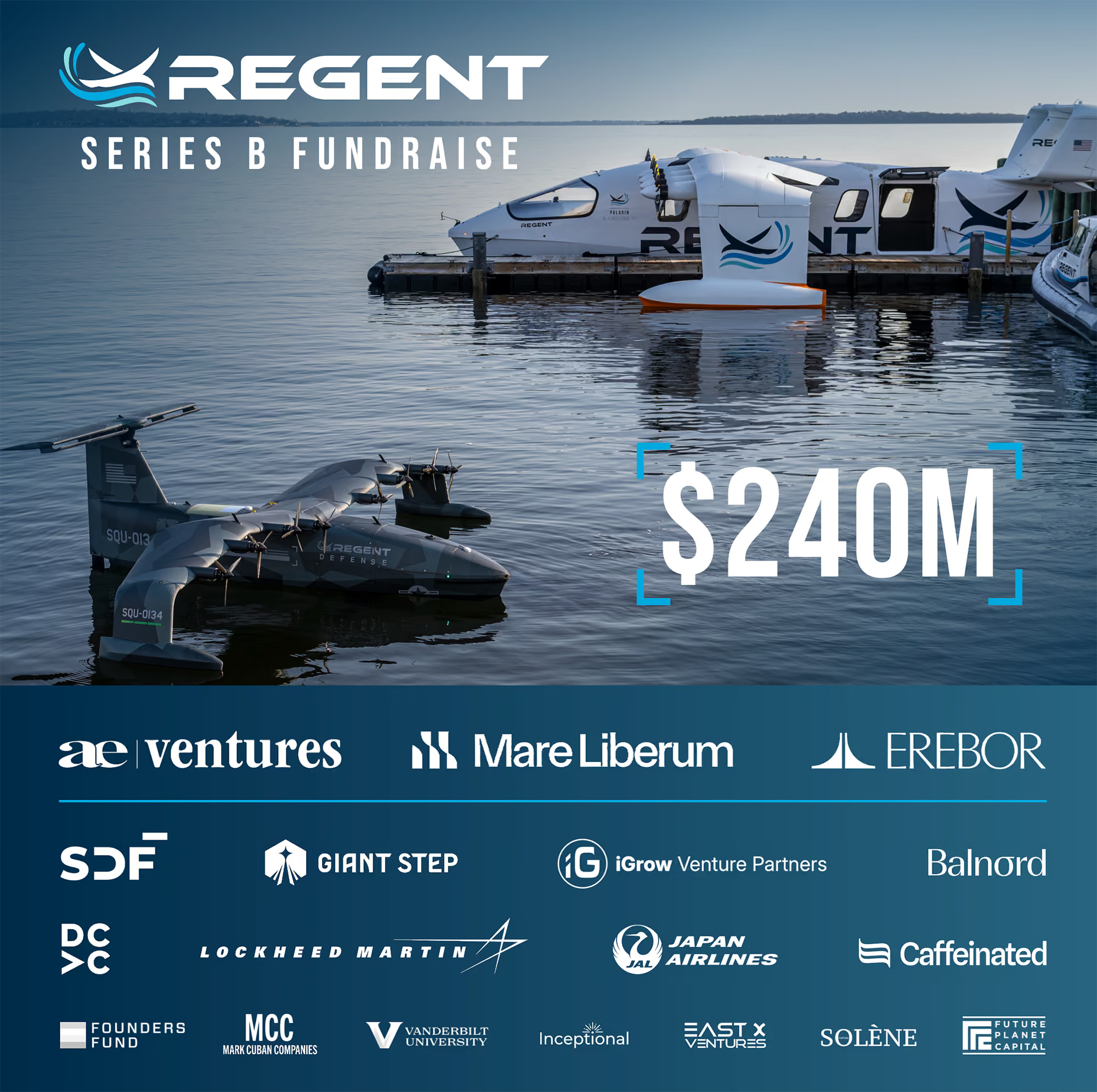
The round will support REGENT's transition toward full-scale manufacturing.
View Press Release
Aviation Week: REGENT flies Squire drone in first wing-in-ground effect test





This article was originally published on Aviation Week.
By Ben Goldstein
NORTH KINGSTOWN, Rhode Island–Regent has completed the first wing-in-ground effect (WIG) flight of its Squire seaglider drone, marking a key step in the development of the company’s emerging defense product line.
The milestone signals a return to flight for Regent’s subscale platform after earlier concept validation work in 2023 and comes as the company increasingly emphasizes military applications alongside its commercial program. Squire is being developed as an uncrewed maritime platform capable of high-speed, low-altitude operations over water, with the ability to land, loiter and relaunch in challenging sea states.
“It’s super exciting to have seagliders in the air again,” co-founder and CEO Billy Thalheimer said. “We proved the core physics a few years ago—float, foil, fly–and that transition between them. This latest flight is really about showing everything still works as expected on a more product-oriented platform, and now we’re operating at a much higher cadence than we were on that original vehicle.”
The Squire platform is derived from Regent’s quarter-scale demonstrator but incorporates updated systems and is being matured toward operational use. The company is now focused on expanding the vehicle’s flight envelope, including longer-duration missions, autonomous operations and payload integration.
Initial flights lasted on the order of minutes, but Regent expects to extend that to tens of nautical miles as testing progresses. The company is also planning demonstrations with defense partners to validate mission capabilities, including intelligence, surveillance and reconnaissance (ISR), logistics and electronic warfare payloads.
The squire is designed for speeds up to 70 kt. (81 mph), a planned operational range of more than 100 nm and a 50-lb. payload.
The Squire program is gaining traction as military interest in unmanned maritime systems accelerates. Thalheimer said demand signals from U.S. defense organizations have increased notably in recent months, with particular attention on systems that can operate across wide maritime areas without relying on fixed infrastructure.
“There’s a strong shift toward unmanned and autonomous operations, and we’re seeing that in the level of engagement,” he said. “Air vehicles have limited loiter time and require complex recovery, while surface vessels aren’t very fast. What Squire does is combine both—it can move quickly, land on the water, stay there indefinitely and then relaunch to execute a mission. That’s a pretty unique capability.”
Thalheimer pointed to current maritime security challenges as a potential use case for the platform. In constrained environments such as the Strait of Hormuz, where larger vessels can be vulnerable to smaller and faster threats, a platform like Squire would be well suited for rapid response and distributed operations.
“You can have a small drone that repositions very quickly across a large area of water, and then actually do something when it gets there,” he said. “It can land, deploy sensors, operate alongside a larger vessel or just loiter and monitor. We think of it almost like a loyal wingman in the maritime domain—something that’s always present and can support higher-value assets.”
Regent is now working to translate the Squire prototype into a production-ready system, including establishing a manufacturing pipeline and refining cost targets. The company plans to leverage its existing 255,000-ft.² facility under construction in North Kingstown to support both Squire and its larger Viceroy seaglider.
In parallel, testing continues on the full-scale, 12-passenger Viceroy prototype in Narragansett Bay. The all-electric vehicle has completed crewed float and hydrofoil trials and is progressing toward its first WIG flight.
“We learned a lot through last year’s test campaign and made a number of improvements over the winter,” Thalheimer said. “We’ve upgraded control systems, actuators and hydrofoils, and we’re already seeing tighter performance in the data. That gives us confidence as we move into higher-speed foiling and eventually flight.”
Regent expects the Viceroy to achieve first liftoff later this year as it expands the test envelope. The company is also developing a hybrid-electric variant for defense applications, which will replace part of the battery system with a turbogenerator to extend range while maintaining a common platform design. A second prototype that is planned to be outfitted with the hybrid powertrain is now under development, Thalheimer said.
The dual-use strategy is central to Regent’s strategy, with the same baseline vehicle supporting both commercial and military missions. While defense activity is increasing, Thalheimer said the commercial business continues to grow, with a backlog that extends more than two years into planned production.
The North Kingstown manufacturing facility remains on track to come online this year, with initial operations supporting both programs. Regent is targeting first deliveries of the Viceroy in late 2027, with certification proceeding through the U.S. Coast Guard.
“We’re continuing to move forward on both fronts,” Thalheimer said. “The technology is the same at its core, and that’s what allows us to scale across these different markets.”