
REGENT Secures $240 Million Series B
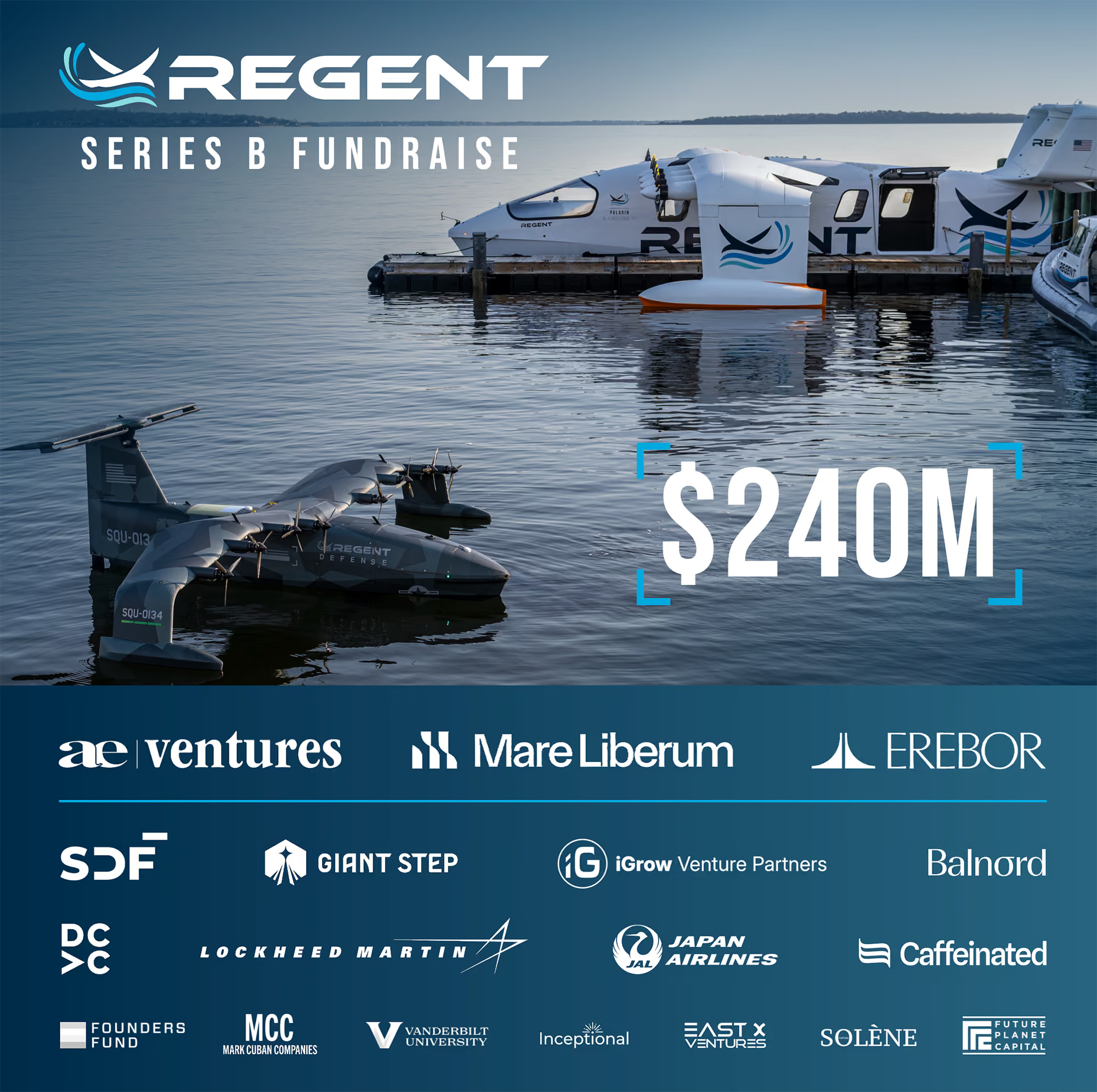
The round will support REGENT's transition toward full-scale manufacturing.
View Press Release
Congress just solidified the regulatory future of wing-in-ground craft like Seagliders

.jpg)



On April 30, President Trump signed the FY2026 Department of Homeland Security Appropriations Act into law, ending a 75-day partial DHS shutdown. That legislation includes a directive that will shape the future of coastal transportation in the United States, creating regulatory certainty for a new class of maritime transportation, wing-in-ground (WIG) craft.
A WIG is a type of maritime vehicle that flies just above the surface of the water by taking advantage of a specific aerodynamic phenomenon called the ground effect. Seagliders are Type A WIGs, which means they always remain in ground effect, within a wingspan of the surface of the water.
The International Maritime Organization (IMO) provides guidance on regulating WIG craft as maritime vessels, and in the U.S., the U.S. Coast Guard oversees the certification process for Seagliders as 46 C.F.R. Subchapter T maritime small passenger vessels. As Seagliders move closer to entering into service, there’s a growing need to translate concepts into practice and ensure a clear certification pathway. With this bill signing, Congress has now explicitly directed the Coast Guard to lead the regulatory effort and provided the necessary funding to do so.
What the bill says
House Report 119-173 contains language that names wing-in-ground (WIG) craft explicitly and directs the Coast Guard to build the capacity to certify and inspect them.
The bill backs that directive with $2.5 million above the president’s budget request for the Coast Guard marine inspection and innovation standards, with explicit instructions to apply those funds to WIG certification and inspection activities.
This is Congress putting resources behind a specific technology and telling the lead regulatory agency to get ready.
Here is what the House Appropriations Committee wrote:
"The Committee is encouraged by new transportation solutions in the maritime industry including the development of electric wing-in-ground coastal passenger vessels... the Coast Guard is directed to develop the capacity to provide wing-in-ground craft certification and inspections."
Three things stand out in that language:
First, Congress named the technology explicitly. The language doesn’t say “advanced maritime vehicles” or “novel craft.” Instead, they specifically named wing-in-ground coastal passenger vessels. That specificity matters – it tells the Coast Guard exactly what to prioritize and signals to the broader maritime industry that Congress understands what is coming.
Second, the directive is about capacity, not just rules. Certification and inspection require trained personnel, developed standards, and institutional process. Congress is not asking the Coast Guard to study the industry and write a report or issue a regulation and wait. Instead, Congress is funding the infrastructure that makes certification possible: design reviews, training systems, and waterway management analyses.
Third, Congress grounded the directive in public benefit. The report language cites increased efficiency, faster coastal and inter-island transportation, and reduced passenger costs. That framing is significant. It establishes WIG craft not as an experimental curiosity but as a transportation solution with a clear public interest case. That rationale will carry weight in future appropriations cycles, in international regulatory alignment discussions, and across the broader advanced maritime mobility ecosystem.
Why it matters
What makes this legislation critical is the combination of direct language with dedicated funding. With the DHS shutdown now resolved, Coast Guard staff can resume active work on WIG design reviews, develop training system for both inspectors and operators, and advance waterway management protocols. The machinery of certification is turning.
At REGENT, we have been working directly with the Coast Guard and with Congress to ensure that the regulatory framework keeps pace with innovation. Our engagement spans design review coordination, operational safety standards development, and advocacy for the resources the Coast Guard needs to do the work well.
We build wing-in-ground vessels designed for coastal passenger transportation and maritime defense missions. A clear, well-resourced regulatory pathway is essential to bring these vessels to market safely and at scale. We are dedicated to ensuring human safety is kept paramount in our design, manufacture, and operation of Seagliders. Our passengers and warfighters deserve nothing less.
The WIG industry is growing. The regulatory environment is now growing with it. That alignment between technology development and government capacity-building is exactly what a maturing industry needs.
We are glad to see Congress working to give the Coast Guard the necessary resources and direction needed to lead the regulatory oversight necessary for safe, effective, and efficient maritime transportation.